Sikkim STET 2026: Apply Soon, Exam on October 11
Education Department, Government of Sikkim
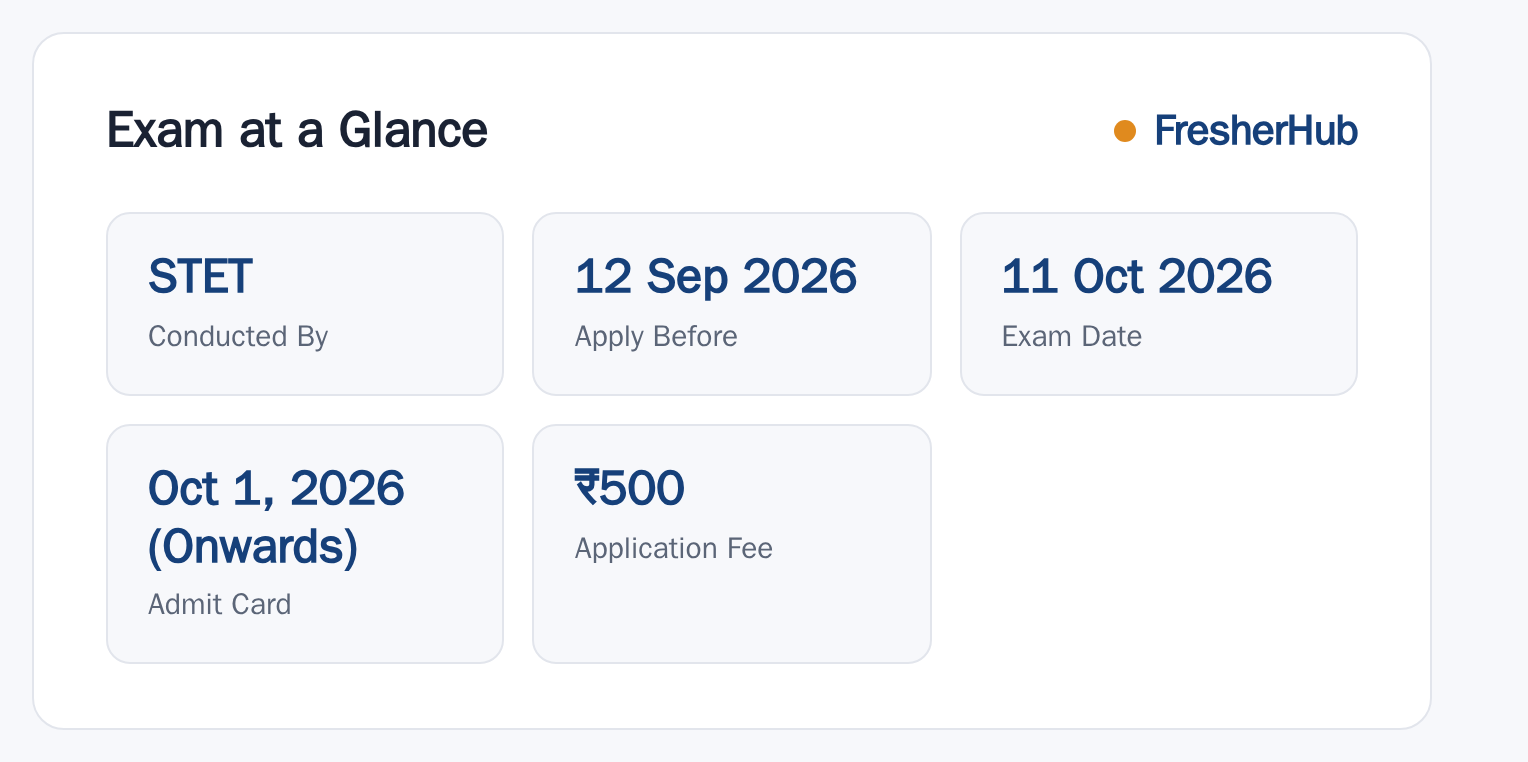
Sikkim STET 2026 is a recruitment notified by Education Department, Government of Sikkim. Applications closed on 12 Sept 2026.
Key Details
- Application Dates: 24 Aug 2026 to 12 Sept 2026 Important Dates
- Exam Date: 11 Oct 2026 Important Dates
- Application Fee: ₹500 for every category the notice lists Application Fee
Eligibility Criteria
- Educational Qualification: For Paper I: Senior Secondary or equivalent with at least 50% marks and a 2-year Diploma in Elementary Education, a 4-year Bachelor of Elementary Education, or a 2-year Diploma in Education (Special Education). For Paper II: B.A./B.Sc. with at least 50% marks and a 2-year Diploma in Elementary Education or 2-year Bachelor in Education; or specified Senior Secondary and 4-year teacher-education qualifications. Eligibility
Selection, Pattern and Syllabus
- Selection Process: Paper I (Primary Level) or Paper II (Graduate Level) → STET certificate award for candidates who qualify Selection Process
- Exam Pattern: Paper I (Primary Teacher – Classes I to V), Paper II (Graduate Teacher – Classes VI to VIII) — 9 sections in all Exam Pattern
- Negative Marking: No negative marking Exam Pattern
- Syllabus: 7 subjects — Child Development and Pedagogy, Language I, Language II, Mathematics, Environmental Studies, Science and 1 more Syllabus
About Sikkim STET 2026
The Examination Section, Education Department, Government of Sikkim, published the Sikkim State Teacher Eligibility Test 2026 notification.
This test is for in-service regular teachers. You can choose Paper I or Paper II.
- Paper I is for Primary Teacher classes I to V.
- Paper II is for Graduate Teacher classes VI to VIII.
- Candidates who qualify receive an STET certificate.
How to apply and what to do now

Online applications start on August 24, 2026. You can apply until September 12, 2026, up to 4:00 PM.
- Check whether you meet the Paper I or Paper II qualification.
- Apply online during the stated application period.
- Pay the application fee of 500.
- Check for admit card downloads from October 1, 2026 onwards.
- Prepare for the exam scheduled on October 11, 2026.
In Detail
Vacancy Details
The provided notification data does not give a vacancy count or vacancy breakdown.
| Applicant category | Fee |
|---|---|
| All applicants | 500 |
Important Dates
| Event | Date |
|---|---|
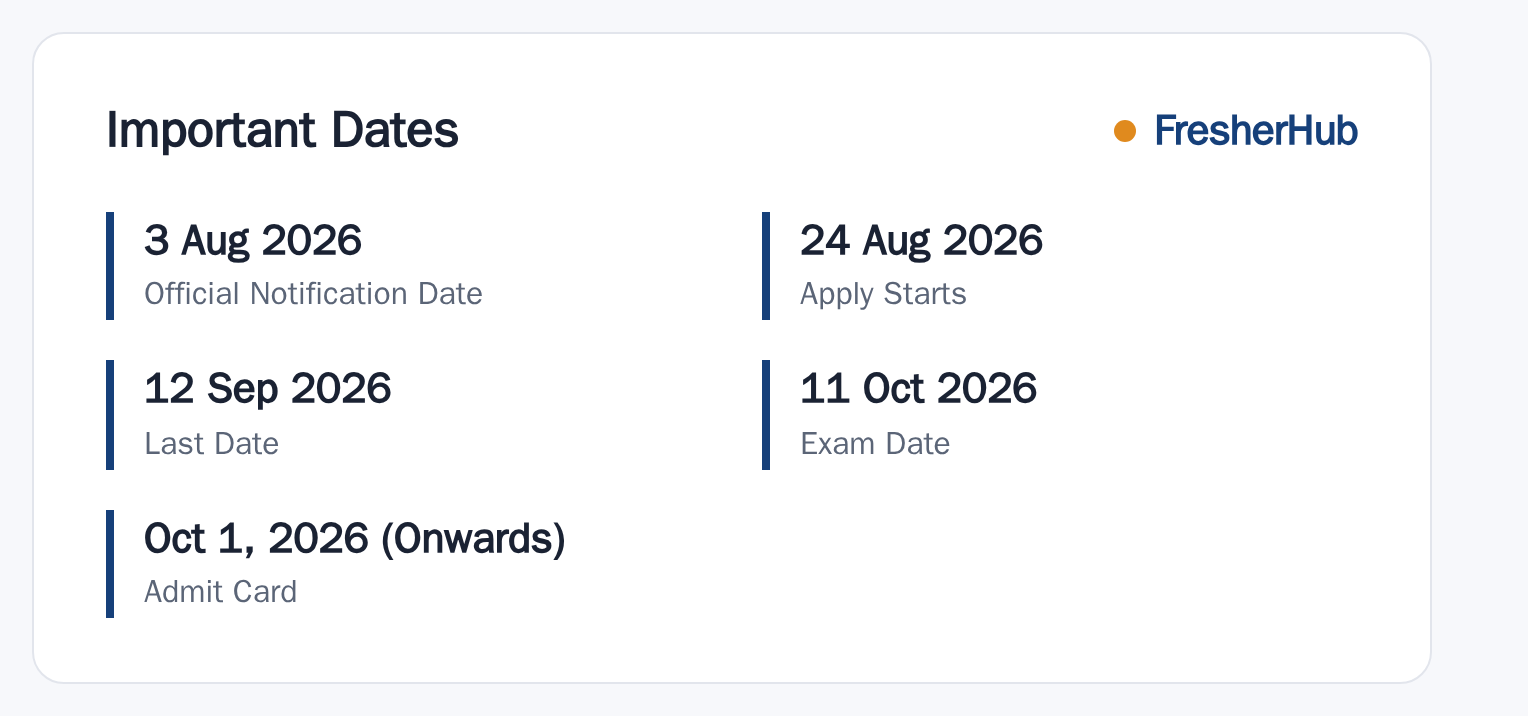
| Official notification date | August 3, 2026 |
| Online application starts | August 24, 2026 |
| Last date to apply online | September 12, 2026, up to 4:00 PM |
| Admit card download | October 1, 2026 onwards |
| Sikkim TET 2026 exam | October 11, 2026, Sunday |
Every date Education Department, Government of Sikkim printed for Sikkim STET 2026, exactly as the notification states it. A date the notice gave as a range or a month is shown in its own words rather than pinned to a day it never named.
| Event | Date |
|---|---|
| Official Notification Date | 03 Aug 2026 |
| Online Application Start Date | 24 Aug 2026 |
| Last Date to Apply Online | 12 Sept 2026 |
| Admit Card Download Date | October 1, 2026 (Onwards) |
| Sikkim TET 2026 Exam Date | 11 Oct 2026 |
Application Fee
Application fee for Sikkim STET 2026 by category, as printed in the official notification. Pay it before the last date — an application whose fee has not reached the board is not a submitted application.
| Category | Fee | Note |
|---|---|---|
| All Applicants | ₹500 | — |
Eligibility
The provided notification data does not state a minimum age, maximum age, or age relaxation.
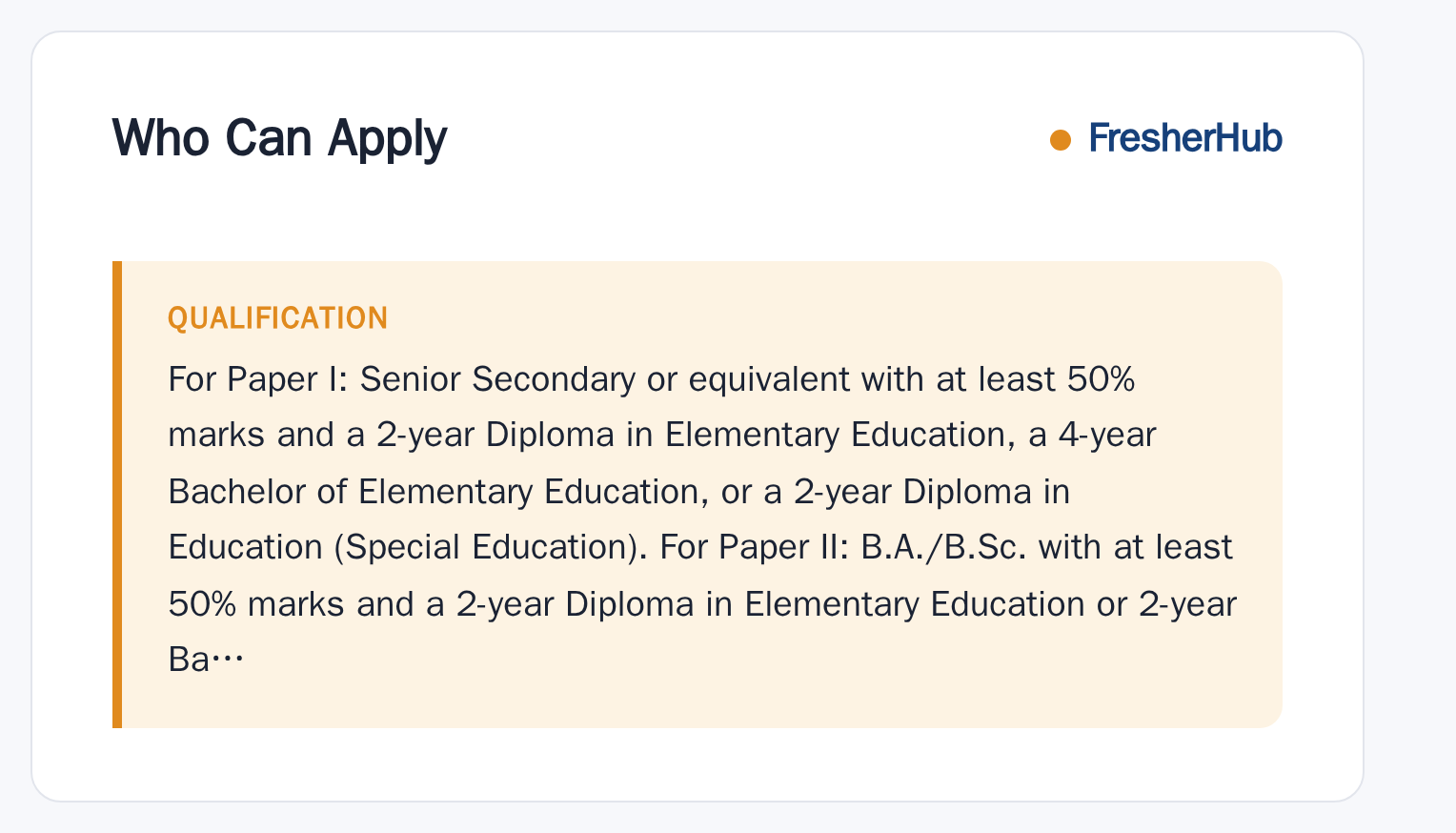
For Paper I, you need Senior Secondary or equivalent with at least 50% marks and a listed teacher education qualification.
Accepted Paper I qualifications include a 2-year Diploma in Elementary Education, a 4-year Bachelor of Elementary Education, or a 2-year Diploma in Education in Special Education.
For Paper II, you need B.A. or B.Sc. with at least 50% marks and a 2-year Diploma in Elementary Education or a 2-year Bachelor in Education.
Specified Senior Secondary qualifications with 4-year teacher education qualifications are also accepted for Paper II.
The minimum marks requirement is 45% for SC, ST, Central OBC, and State OBC candidates.
NCTE must recognize teacher education qualifications. RCI must recognize Special Education programs.
Educational Qualification
For Paper I: Senior Secondary or equivalent with at least 50% marks and a 2-year Diploma in Elementary Education, a 4-year Bachelor of Elementary Education, or a 2-year Diploma in Education (Special Education). For Paper II: B.A./B.Sc. with at least 50% marks and a 2-year Diploma in Elementary Education or 2-year Bachelor in Education; or specified Senior Secondary and 4-year teacher-education qualifications.
The minimum marks requirement is 45% for SC, ST, Central OBC and State OBC candidates. Teacher Education qualifications must be recognized by NCTE; Special Education programs must be recognized by RCI.
Exam Pattern
| Paper | Subject | Questions | Marks |
|---|---|---|---|
| Paper I | Child Development and Pedagogy | 30 | 30 |
| Paper I | Language I (English) | 30 | 30 |
| Paper I | Language II (Selected Vernacular Language) | 30 | 30 |
| Paper I | Mathematics | 30 | 30 |
| Paper I | Environmental Studies | 30 | 30 |
| Paper II | Child Development and Pedagogy | 30 | 30 |
| Paper II | Language I (English) | 30 | 30 |
| Paper II | Language II (Selected Vernacular Language) | 30 | 30 |
| Paper II | Mathematics and Science for Math or Science Teachers, or Social Studies for Social Studies Teachers | 60 | 60 |
- General candidates need 60% qualifying marks.
- SC, ST, Central OBC, and State OBC candidates need 55% qualifying marks.
- There is no negative marking.
Paper I (Primary Teacher – Classes I to V)
| Section | Questions | Marks | Duration |
|---|---|---|---|
| Child Development and Pedagogy | 30 | 30 | — |
| Language I (English) | 30 | 30 | — |
| Language II (Selected Vernacular Language) | 30 | 30 | — |
| Mathematics | 30 | 30 | — |
| Environmental Studies | 30 | 30 | — |
| Total | 150 | 150 |
Paper II (Graduate Teacher – Classes VI to VIII)
| Section | Questions | Marks | Duration |
|---|---|---|---|
| Child Development and Pedagogy | 30 | 30 | — |
| Language I (English) | 30 | 30 | — |
| Language II (Selected Vernacular Language) | 30 | 30 | — |
| Mathematics and Science (for Math/Science Teachers) OR Social Studies (for Social Studies Teachers) | 60 | 60 | — |
| Total | 150 | 150 |
Selection Process
- Paper I (Primary Level) or Paper II (Graduate Level)
- STET certificate award for candidates who qualify
Syllabus
The syllabus covers child development, languages, mathematics, environmental studies, science, and social studies.
- Child Development and Pedagogy includes child growth, learning theories, inclusive education, and assessment.
- Language I includes reading, grammar, vocabulary, literature, language teaching, and remedial teaching.
- Language II includes language comprehension, language learning, listening, speaking, reading, and writing.
- Mathematics includes numbers, algebra, geometry, measurement, data, probability, and teaching methods.
- Environmental Studies includes food, science, history, geography, society, and teaching methods.
- Science includes motion, force, energy, matter, cells, electricity, and science teaching.
- Social Studies includes Indian history, geography, environment, democracy, rights, government, and trade.
| Subject | Topics |
|---|---|
| Child Development and Pedagogy | Concept and principles of development and its relationship with learning, principles of growth and development, factors influencing growth and development, domains of development and milestones in early and middle childhood, gross and fine motor skills, cognitive development, social development, emotional development, development of speech and language, language development in different ages, factors influencing language development, uses of language, socialisation processes, parenting, schooling, early childhood care and education, theoretical constructs and critical perspectives, Piaget’s stages of cognitive development, Kohlberg’s theory, National Policy on Education, National Curriculum Framework 2005, National Education Policy 2020, Right of Children to Free and Compulsory Education Act 2009, inclusive education, individual differences among learners, learning disabilities, children with disabilities, gifted learners, child labour and child abuse, theories of learning, Gagne’s classification, Gagne’s hierarchical theory of learning, Pavlov’s classical conditioning, Thorndike trial and error learning, Skinner’s operant conditioning learning, Bandura and Walter’s social learning theory, Vygotsky’s theory, Zone of Proximal Development, Bloom’s Taxonomy, factors contributing to learning, concept formation, thinking and reasoning, learning processes, transfer of learning, approaches of teaching and learning, play, assessment and learning, measures of central tendency, anecdotal records, observation, checklists, portfolio, formative and summative assessment, validity, reliability, fairness, objectivity |
| Language I | Unseen passages, reading comprehension, skills of reading, skimming and scanning, prediction, visualisation, summarisation, inferences, conclusions, assumptions, textual evidence, cause-effect, point of view, grammar knowledge, functional and communicative grammar, adjectives, adverbs, prepositions, determiners, modals, tenses, clauses, subject-verb concord, commands and requests, statements, questions, vocabulary, synonyms and antonyms, shades of meaning, semantic gradients, figures of speech, metaphor, symbol, image, rhyme scheme, alliteration, onomatopoeia, responding to literature, plot, character, setting and intention, critical thinking, gender, inclusion and stereotypes, language policies and languages in school education, three language formula, Language Policy of Sikkim, language diversity and multilingual contexts, Cummins’ theory of language interdependence, code-mixing and code-switching, teaching English as the medium of instruction, language across the curriculum, language acquisition and language learning, Chomsky’s Language Acquisition Device, Bruner’s Language Acquisition Support System, whole language and task-based communicative approaches, storytelling and children’s literature, curricular materials and planning, teaching-learning materials, assessing language, teaching literature, teaching grammar, remedial teaching |
| Language II | Unseen prose passages, language comprehension, pedagogy of language development, learning and language acquisition, principles of language teaching, listening and speaking, grammar in language learning, language difficulties, errors and disorders, speaking, listening, reading and writing, language comprehension and proficiency, textbooks, multimedia resources, multilingual classroom materials, remedial teaching |
| Mathematics | Numbers, squares, square roots, cubes, cube roots, integers, decimals, fractions, algebraic expressions, identities, factorizations, rational numbers, exponents, powers, addition, subtraction, operations on numbers, ratios, proportions, measurement, comparisons, geometry, spatial understanding, solids, mensuration, weight, data handling, patterns, currency, nature of mathematics and logical thinking, children’s thought processes, reasoning patterns, learning strategies, role of mathematics within the curriculum, language of mathematics, community-based mathematics, formal and informal assessment, teaching challenges, error analysis, diagnostic and remedial teaching, whole numbers, real numbers, number system, algebra, polynomials, remainder theorem, linear equations, quadratic equations, arithmetic progressions, trigonometric ratios, specific angles, complementary angles, trigonometric identities, heights and distances, basic geometrical ideas, lines, angles, triangles, polygons, circles, elementary shapes, symmetry, surface areas and volumes, coordinate geometry, mean, median, mode, probability |
| Environmental Studies | Food sources and components, nutrition in plants and animals, light, shadows, reflection, electric current and its effects, sound, microorganisms as friends and foes, air and water pollution, physical and chemical changes, journey from fiber to fabric, history, transition from gathering to growing food, rulers and their architectural contributions, India’s history after gaining independence, geography, movements of the Earth, life in temperate grasslands, mineral and energy resources, social and political life, diversity, discrimination, media, marginalization, meaning and nature of environmental studies, objectives for teaching environmental studies, approaches to teaching environmental studies, child-centric activity-based classroom, child-centered approach, children’s unique needs, diverse skills, planning and conducting activities, teaching methods, problem-solving, question-answer, project-based, play-based, storytelling and scientific methods, teaching-learning materials, lesson planning, continuous and comprehensive evaluation, assessment and evaluation, formative and summative assessment, summative assessment tools and techniques, types of questions, NCERT Model, grading system |
| Science | Motion, velocity, acceleration, force and laws of motion, gravitation, work and energy, sound, light, reflection, refraction, electricity, magnetism, matter, elements, compounds, cells, tissues, nature and structure of science, aims and objectives for science education, physics, chemistry and biology, scientific methods and inquiry, science curriculum, approaches and methods for teaching science, lesson planning, learning resources, learner progress, diagnostic and remedial teaching |
| Social Studies | Ancient, Medieval, and Modern India, physical and political geography, environment, democracy, government, rights, constitution, governance, citizenship, resources, economic development, trade |
Admit Card, Exam Date, Result and Answer Key
- Admit Card
- October 1, 2026 (Onwards) — full details
- Exam Date
- 11 Oct 2026 — full details
- Result
- STET has not announced a date yet. This page updates the day the notice does.
- Answer Key
- STET has not announced a date yet. This page updates the day the notice does.
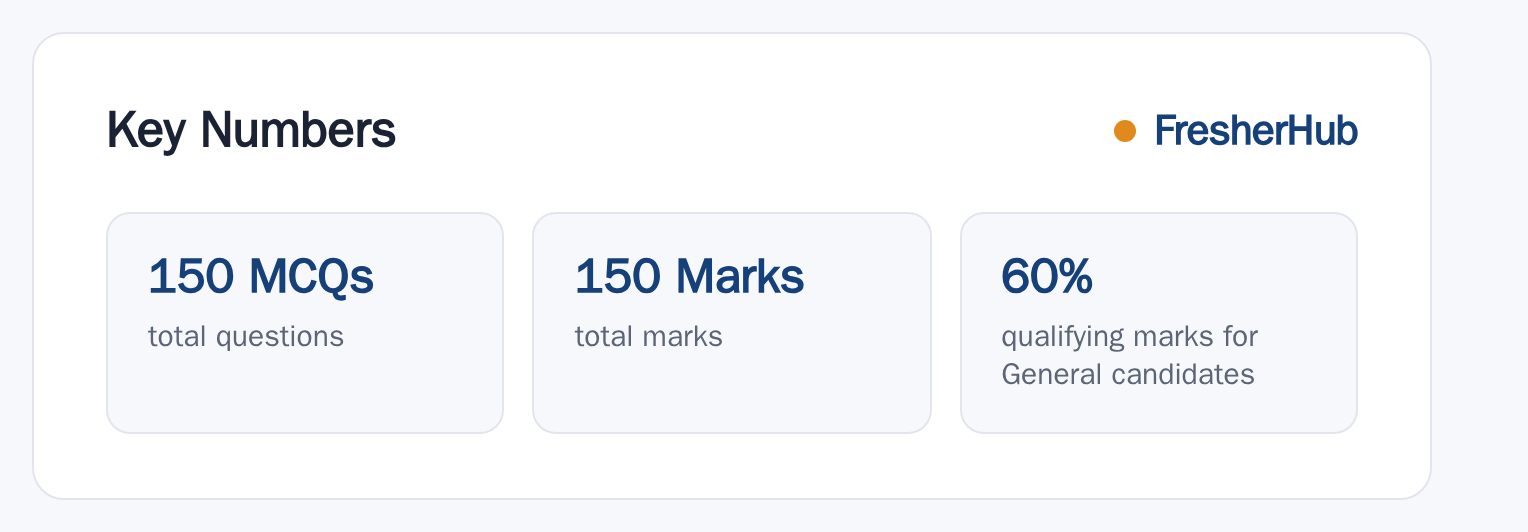
Key Numbers
| What | As stated in the notification |
|---|---|
| total questions | 150 MCQs |
| total marks | 150 Marks |
| qualifying marks for General candidates | 60% |
| qualifying marks for SC, ST, Central OBC and State OBC candidates | 55% |
More jobs like this
Related recruitments
The exam pattern, selection process and syllabus above were not printed in this recruitment's own notice and are compiled from: Sikkim TET exam pattern, Sikkim TET syllabus, Sikkim TET Syllabus 2025: Exam Pattern and Subject-Wise..., SIKKIM TET Syllabus 2025 Paper I & Paper II, Exam Pattern - UGC.... Every date, vacancy count and fee on this page comes from the official notification, never from these.
Frequently Asked Questions
When will Sikkim STET 2026 applications start?
Online applications start on August 24, 2026.
What is the last date to apply for Sikkim STET 2026?
The last date is September 12, 2026, up to 4:00 PM.
When is the Sikkim STET 2026 exam?
The exam is scheduled for October 11, 2026.
What is the Sikkim STET application fee?
The fee is 500 for all applicants.
How many questions are in the Sikkim STET exam?
The exam has 150 multiple-choice questions for 150 marks.
Is there negative marking in Sikkim STET 2026?
No, there is no negative marking.
What is the qualifying mark for General candidates?
General candidates need 60% qualifying marks.
How we know this
Every date, vacancy count, fee and age limit above is transcribed from the recruiting body's own notification and checked back against that document before it is published. A figure FresherHub cannot find in the source is left off the page rather than estimated. How we verify every page.
- Tracked since 28 Aug 2026 — 6 changes recorded to this recruitment, the latest on 29 Aug 2026.
- 2 official links checked — 2 working.
- Last checked against the source on 29 Aug 2026 — the day this recruitment last moved, not the day this page was last rebuilt.
Found something wrong on this page? Tell us — corrections are made against the official document and the change is added to the update history above. For anything you are about to act on, always confirm on the department's own website first.